
|
|
There are several types of deworming compounds: Ivermectin, Moxidectin, Fenbendazole, Pyrantels (Pyrantel Pamoate), and Quasiquantels. Each compound works a little differently in the horse to destroy internal parasites, and each plays a different role in a rotational deworming program.
Ivermectin (trade names include Eqvalan®, Zimecterin®, Rotation 1® and others) was introduced in 1983 and is actually an antibiotic (Streptomyces avermitillis) that is a fermentation product of a microorganism. Ivermectin acts to disrupt a neuro-muscular transmitting chemical called GABA. In lower life forms (parasites), GABA is found throughout the body. Disruption of GABA causes the parasite to become immobile and death ensues slowly. In the mammalian host, GABA is limited to the central nervous system, brain and spinal cord and therefore protected from the effects of ivermectin.
Some parasites, such as tapeworms and flukes, do not contain GABA. Therefore, ivermectin has no effect on these parasites. Some horses get an infectious disease called sleeping sickness, which temporarily breaks down the protective covering of the Central Nervous System (CNS). Therefore, care should be taken to avoid administering ivermectin to horses diagnosed with sleeping sickness.
At the approved dose of 200mcg/kg bwt, ivermectin is effective against:
- Large strongyles: Strongylus edentatus, Strongylus equinus and Strongylus vulgaris (adult and migrating)
- Small strongyles or cyathastomes (adult only)
- Stomach worms: Trichostrongylus axei, Habronema spp.
- Adult & L4 pinworms: Oxyuris equi
- Adult Ascarids: Parascaris equorum
- Neck Threadworm Micofilaria: Onchocerca cervicalis
- Bots (Oral and Gastric Stages): Gasterophilus spp.
Ivermectin is not effective against:
- EL3 (Encysted early third-stage cyathostome larvae)
- LL3 (Late third-stage cyathostome larvae)
- L4 cyathostomes (Lumenal larvae and adult cyathostomes)
In the summer of 1997, a new chapter of anthelmintic equine dewormers was opened with the introduction of moxidextin (trade name: Quest®). Moxidectin works by interfering with the chloride channel-mediated neurotransmission in the parasite. This results in paralysis and elimination of the parasite. Quest® moxidectin is approved for the control and treatment of:
- Large strongyles: Strongylus edentates (adult and migrating), Strongylus equinus and Strongylus vulgaris (adult and migrating)
- Small strongyles or cyathastomes (adult and L4)
- Hairworms: Trichostrongylus axei
- Adult & immature pinworms: Oxyuris equi
- Adult & immature ascarids: Parascaris equorum
- Bots (2nd & 3rd instars): Gasterophilus spp.
Quest® became the first equine anthelmintic approved for encysted cyathostomes, and moxidectin is effective against late L3 and L4 mucosal cyathostome larvae. However with the majority of the encysted larvae being the EL3 stage (75% EL3 versus 25% LL3/L4), use of moxidectin only controls a small percentage of the total encysted population of larvae.
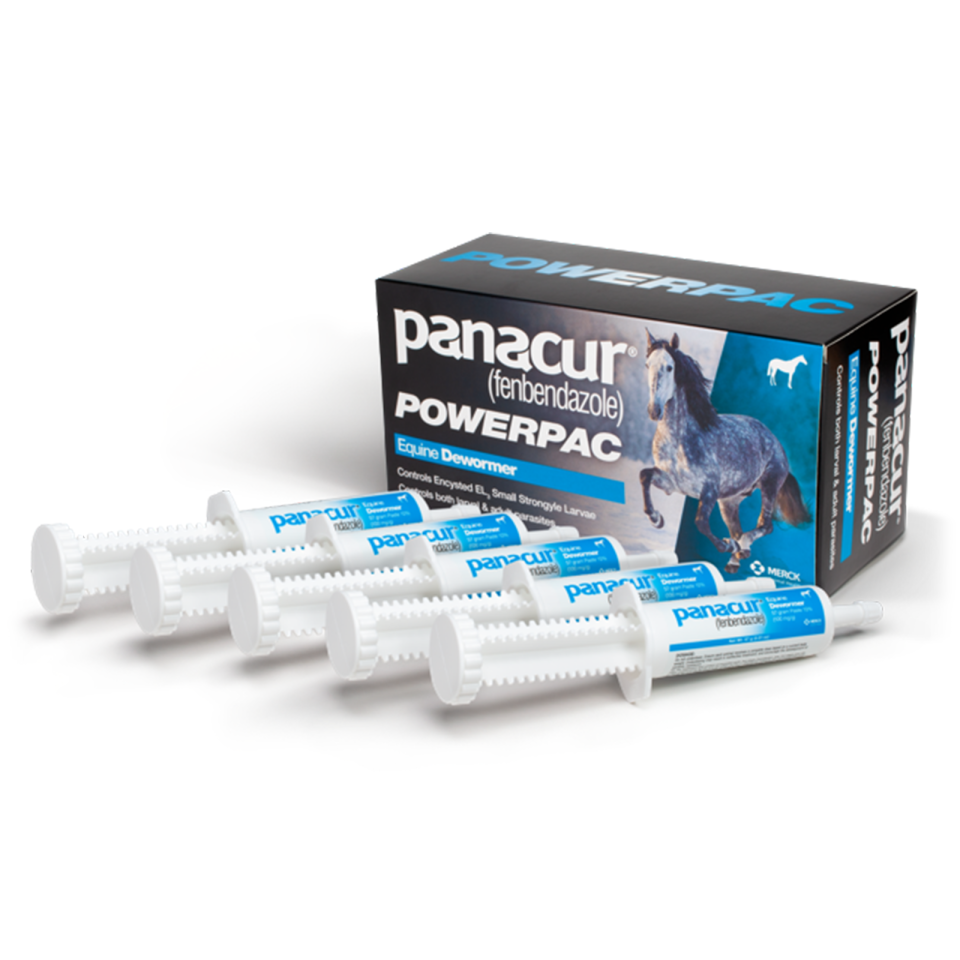
Fenbendazole is a member of the benzimidazole class of chemical compounds. In horses, benzimidazoles are recognized for a wide margin of safety, very good anthelmintic action, and efficacy against a wide spectrum of nematodes. Fenbendazole offers the widest safety margin, and the best efficacy of all benzimidazoles.
Approved in the U.S. in November of 1977 for use in horses, fenbendazole has maintained its commercial value even as most of the remainder of the benzimidazole equine dewormers have come and gone from the market. This is significant. Not all benzimidazoles have the exact same efficacy. Fenbendazole is truly the best of its class.
Fenbendazole is an odorless and tasteless powder, insoluble in water, and insoluble or poorly soluble in conventional solvents. Research indicates that fenbendazole's primary mode of action is through absorption by the worm. This interferes with the parasite's energy metabolism and affects its intracellular structures and functions.
Fenbendazole kills adult worms and many of their developmental stages - including some immature and pre-adult juvenile stages, making it a highly-effective anthelmintic
Fenbendazole is effective against:
- Large strongyles: Strongylus edentates, Strongylus equinus and Strongylus vulgaris
- Small strongyles or cyathastomes
- Pinworms: Oxyuris equi
- Ascarids: Parascaris equorum
The normal dose of fenbendazole is 5 mg/kg bwt; however, where ascarids
are a common problem in foals, weanlings and yearling, fenbendazole
can be dosed at 10 mg/kg to ensure an almost 100% efficacy.
For control of 4th stage (migrating) larvae of Strongylus vulgaris and/or encysted early L3, late L3 and L4 cyathostome larvae, the dose is 10 mg/kg daily for 5 consecutive days. This is significant. Controlled efficacy studies have revealed that up to 75% of encysted small strongyles are actually EL3. Using a larvicidal treatment with Safe-Guard® Power Dose® can provide a 98% reduction of encysted EL3 larvae, and as great as a 96% reduction in LL3 and L4 larvae.
Fenbendazole also provides unsurpassed safety for horses. Fenbendazole is safe to use in horses and ponies including breeding stallions, pregnant mares, young foals and old debilitated animals. Safe-Guard® deworming products with fenbendazole are safe for the animal receiving the product, the person administering the product, and the environment.
Pyrantel pamoate (tradename: Strongid®) is an old anthelmintic for horses, and is also marketed for dogs, cattle and swine as different variations of pyrantel. The recommended dose for horses is 3 mg/lb bwt. Pyrantel is classed as a tetrahydo pyrimidine, and is fairly safe. Though no ill effects are seen at 20X, product labels note that the product should not be used on severely debilitated horses.
Strongid® pyrantel pamoate is approved for the control and treatment of these equine internal parasites:
- Large strongyles: Strongylus edentates, Strongylus equinus and Strongylus vulgaris
- Small strongyles or cyathastomes
- Pinworms: Oxyuris equi
- Ascarids (Large roundworms): Parascaris equorum
In addition, pyrantel is somewhat effective on small strongyles resistant to benzimidazoles.
In today's market, there are several forms of Strongid® available, including: Strongid-T® - a suspension available to veterinarians, Strongid-P® - a paste formulation, Strongid-C® - a topdress anthelmintic to be used as a preventative against parasite infestations, and Strongid-C-2X® - twice the concentration of Strongid-C® and with the same spectrum of efficacy and margin of safety.
Praziquantel (tradenames include: EquiMax™, Zimectrin® Gold, and Quest® Plus) is a compound introduced into the US equine market during the year 2003, and is being used in combination with Ivermectin or Moxidectin. Praziquantel is highly effective in removing tapeworms.
|
 |
|